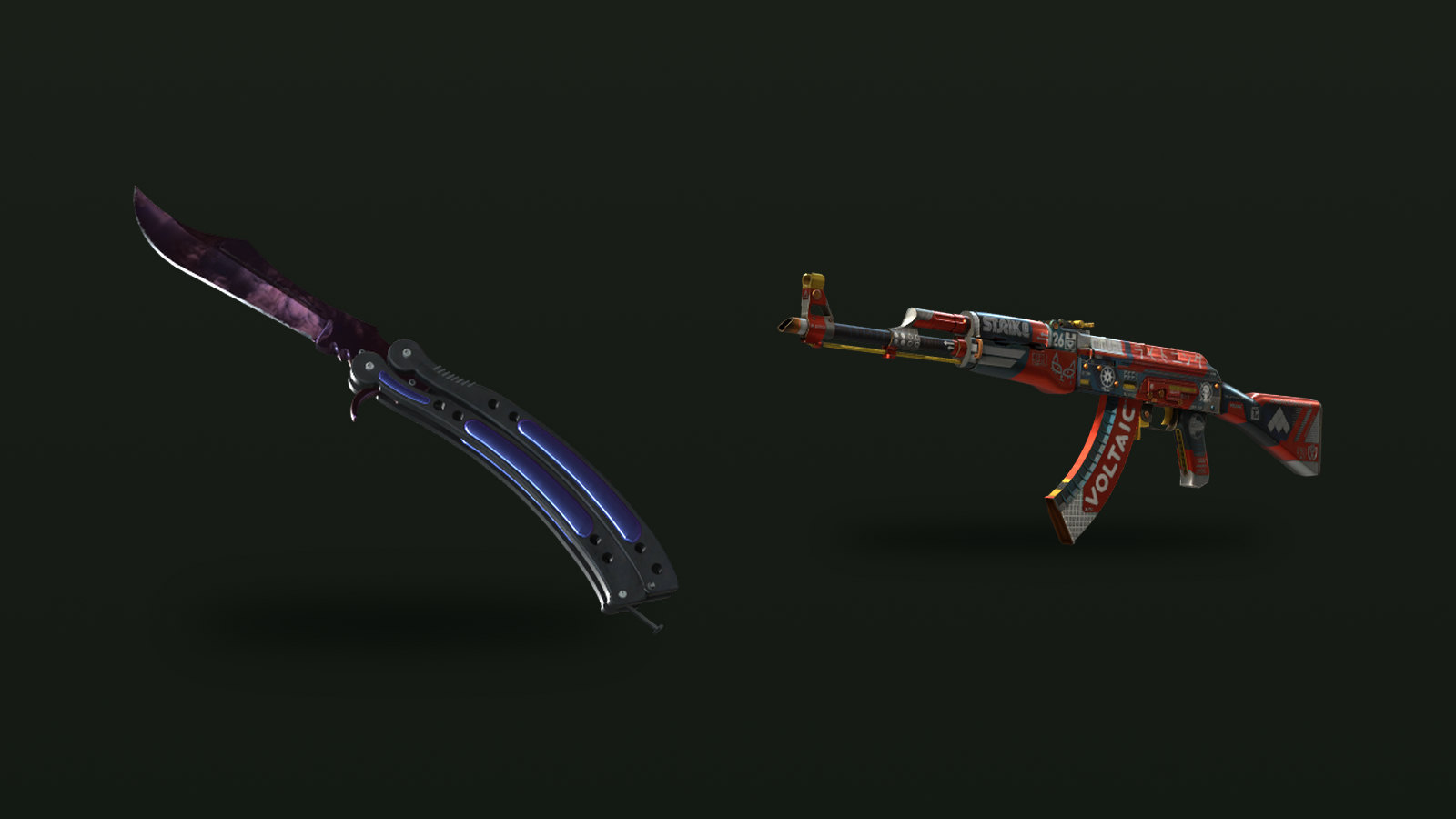
A trade-up contract swaps a batch of skins you own for one skin of a higher grade. The basic idea has existed since 2013, but Valve has changed it twice in the past year: Covert skins can now become knives and gloves, and Souvenir skins can be used as inputs. The maths behind the result also shifted in late 2025, which left many older guides and calculators out of date.
The basic rules
The standard contract takes ten skins of the same grade and returns one skin of the next grade up, picked from a collection of one of the skins you put in. The ladder runs Consumer Grade, Industrial Grade, Mil-Spec, Restricted, Classified, Covert. You find the contract in your inventory by right-clicking a skin and choosing to use it in a trade-up.
According to the Counter-Strike Wiki, a few rules have held for years:
- StatTrak stays with StatTrak. Since March 2015, StatTrak skins can be used, but all inputs must be StatTrak and the result is StatTrak. You can't mix them with normal skins.
- Some items can't go in. Knives, gloves and Contraband skins are excluded, and so is any skin that is already the highest grade in its own collection.
- Consumer Grade is never a result, because nothing sits below it to trade up from.
- Collections can be mixed. That has been allowed since May 2014; before then a contract had to use a single collection.
Covert to knife or gloves
Valve's update of October 22, 2025 added a second kind of contract:
- Five StatTrak Covert items can be exchanged for one StatTrak knife from a collection of one of the inputs.
- Five normal Covert items can be exchanged for one knife or one pair of gloves from a collection of one of the inputs.
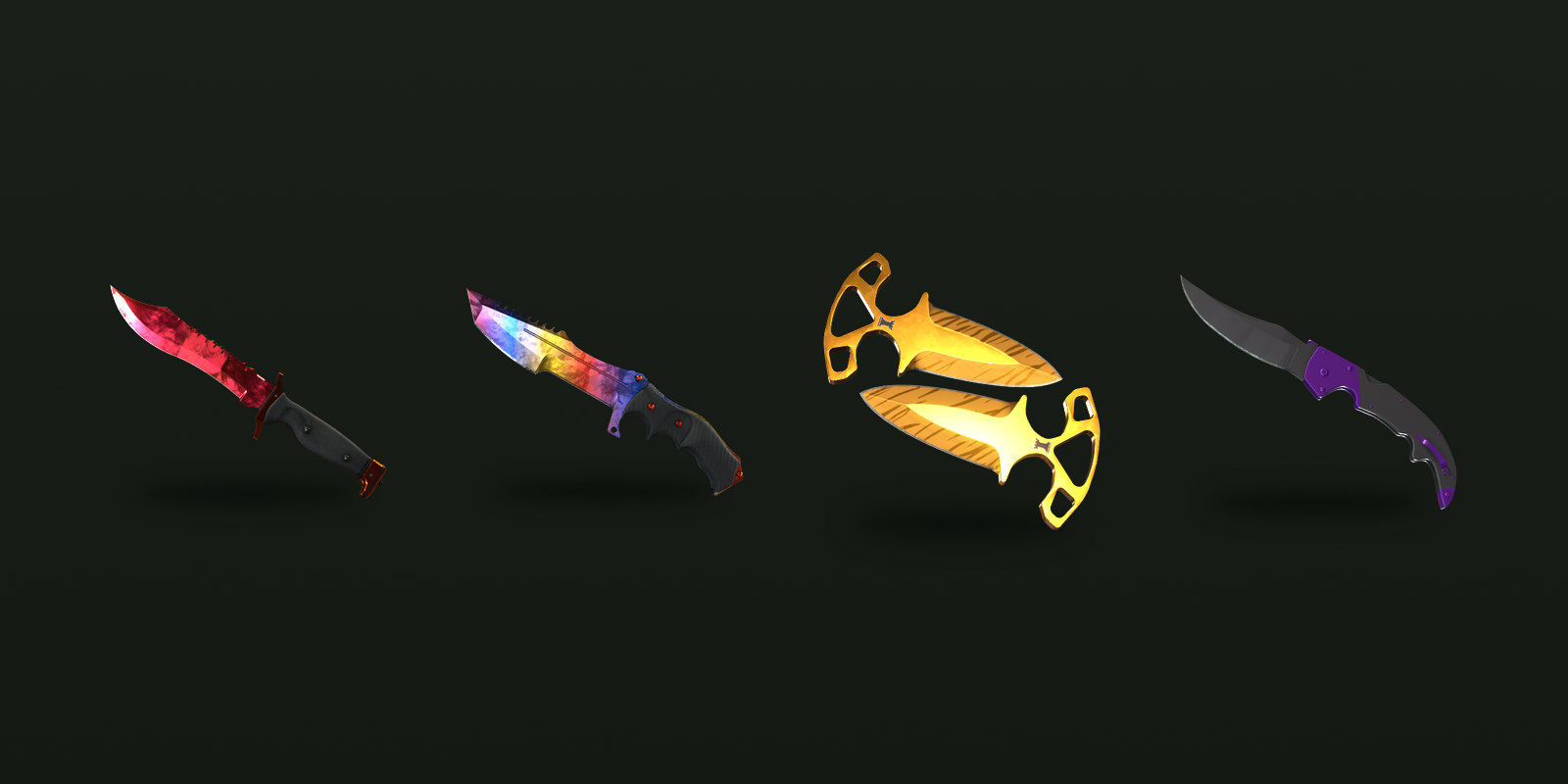
The knives and gloves on offer are the rare special items of the case each Covert comes from. Hotspawn's knife trade-up guide uses the AK-47 | Bloodsport as an example: it comes from the Spectrum Case, so including it puts you in line for that case's Butterfly, Bowie, Falchion, Huntsman and Shadow Daggers finishes. Coverts from collections that have no case, such as map collections, have no knife or glove pool to draw from. The finish and pattern you get are random, so you can't aim for a specific Doppler phase or blue gem.
The change added a large new source of knives. Dot Esports reports that it pushed knife prices down noticeably.
Souvenir inputs
Valve's update of May 22, 2026 allows Souvenir items to be selected alongside normal items. Their Souvenir attributes are removed, and the contract returns a normal item one grade higher. In practice that means a Souvenir's gold stickers and status are gone the moment you sign. Use one only if the skin is worth more to you as trade-up fodder than as a Souvenir.
How the odds work
Valve does not publish the formula for which result you get, and its patch notes only say the result comes from a collection of one of the inputs. Since the October 2025 update, community testing reported in guides such as Money4Gamers' breakdown points to a simple rule:
- Each input counts equally toward its own collection, so a collection's chance equals its share of the inputs.
- Within that collection, each possible result at the next grade is equally likely.
Put seven skins from collection A and three from collection B into a contract, and you have a 70% chance of a result from A and 30% from B. If A has two possible results at the next grade, each gets 35%.
Before the update, guides weighted collections by how many possible results they had, which made "filler" skins from collections with few outcomes a popular way to steer the odds. Under the new rule, fillers no longer shift the odds. Treat all of this as community-tested rather than official.
The float formula
The result's float comes from the floats of your inputs. Community testing since October 2025 shows that each input is first placed within its own skin's range:
- For every input, work out its position: (float − minimum) ÷ (maximum − minimum).
- Average those positions across all inputs.
- The result's float is: output minimum + average × (output maximum − output minimum).
The older formula averaged the raw floats instead. The difference is biggest for float-capped inputs. Money4Gamers gives the example of ten P2000 | Amber Fade inputs at 0.30. That skin's range is 0.00 to 0.40, so each sits at position 0.75. Under the old method the average was 0.30; under the new one it is 0.75, which on a full 0 to 1 output lands deep in Battle-Scarred.
Two consequences are worth remembering:
- Every possible result gets its own float. The same inputs can give a Factory New result from one outcome and a Minimal Wear result from another, because each output skin has its own range.
- Narrow output ranges are forgiving. A Doppler or Fade knife is capped at 0.00 to 0.08, so its float only passes 0.07, the start of Minimal Wear, if your average position is above 0.875. A skin that starts at 0.10, like the AK-47 | Redline, can never come out Factory New. Our float guide lists more caps.
Before you sign
- Use a calculator updated after October 2025. Older tools average raw floats and use the old odds.
- Check every input's float range, not just its float. A capped skin at a modest float can drag the average position up.
- Price the whole outcome list. Work out what each possible result is worth at its predicted float and weigh it by its chance. A contract can look good because of one rare result while most outcomes are worth less than the inputs.
- Remember what you lose. StatTrak counts, Souvenir status and any stickers on the inputs disappear with them.
On CS2Sell, the rarity, collection and float range filters on Buy let you line up inputs from the collections you want at the floats your contract needs.
Sources
- Counter-Strike 2 Update, October 22, 2025 — Steam News
- Counter-Strike 2 Update, May 22, 2026 — Steam News
- Trade Up Contract — Counter-Strike Wiki
- How the New CS2 Trade Up Algorithm Works — Money4Gamers
- Knife CS2 Trade-Up Guide: Which Skins Give Which Knives — Hotspawn
- Karambit Case Hardened Blue Gems: Patterns, prices, and history — Dot Esports