A CS2 trade up calculator does two pieces of arithmetic: the chance of each possible result, and the float each result would come out with. Both can be done by hand from a list of your inputs and their float ranges, which is also the quickest way to check that a calculator uses the current rules. Valve has never published either formula, so what follows is the method community testing arrived at after the October 2025 update.
How a CS2 trade up calculator works
The rules come first. A standard contract takes ten skins of one grade and returns one skin of the next grade, from a collection of one of the inputs. Since October 22, 2025, five Covert skins can instead become a knife or gloves, and five StatTrak Coverts a StatTrak knife. Since May 22, 2026, Souvenir skins can go in too; Valve removes their Souvenir attributes and the result is a normal item. StatTrak and normal skins can't be mixed, and knives, gloves, Contraband skins and skins already at the top of their collection can't be used. Our trade-up contract guide covers the rules in full.
For every input, a calculator needs its collection, its grade, its float and its finish's float range. For every collection, it needs the skins one grade up and their ranges. Valve's item file, items_game.txt, holds all of it: each collection's skins sorted into grades, and a minimum and maximum float for each finish. A finish with no range of its own, such as Crimson Web, uses the file's default of 0.06 to 0.80.
Step 1: outcome odds per collection
Community testers, including a Steam Community guide by Daka and a breakdown video by the YouTuber slyk, agree on the current rule:
- Every input carries an equal share: 10% in a ten-skin contract, 20% in a five-skin one.
- A collection's chance is the total share of the inputs from it.
- That chance is split evenly between the collection's skins at the next grade.
Worked example 1. Seven Restricted skins from The Kilowatt Collection, such as M4A4 | Etch Lord or MP7 | Just Smile, plus three Restricted skins from the Train 2025 Collection, such as MAC-10 | Derailment or Zeus x27 | Charged Up.
| Possible result | Collection | Chance now | Older rule |
|---|---|---|---|
| M4A1-S Black Lotus | Kilowatt | 23.3% | 25.9% |
| Zeus x27 Olympus | Kilowatt | 23.3% | 25.9% |
| USP-S Jawbreaker | Kilowatt | 23.3% | 25.9% |
| M4A4 Hellish | Train 2025 | 15% | 11.1% |
| MP9 Latte Rush | Train 2025 | 15% | 11.1% |
Kilowatt holds 70% of the inputs and has three Classifieds, so each gets a third of 70%. Train 2025 holds 30% and has two.
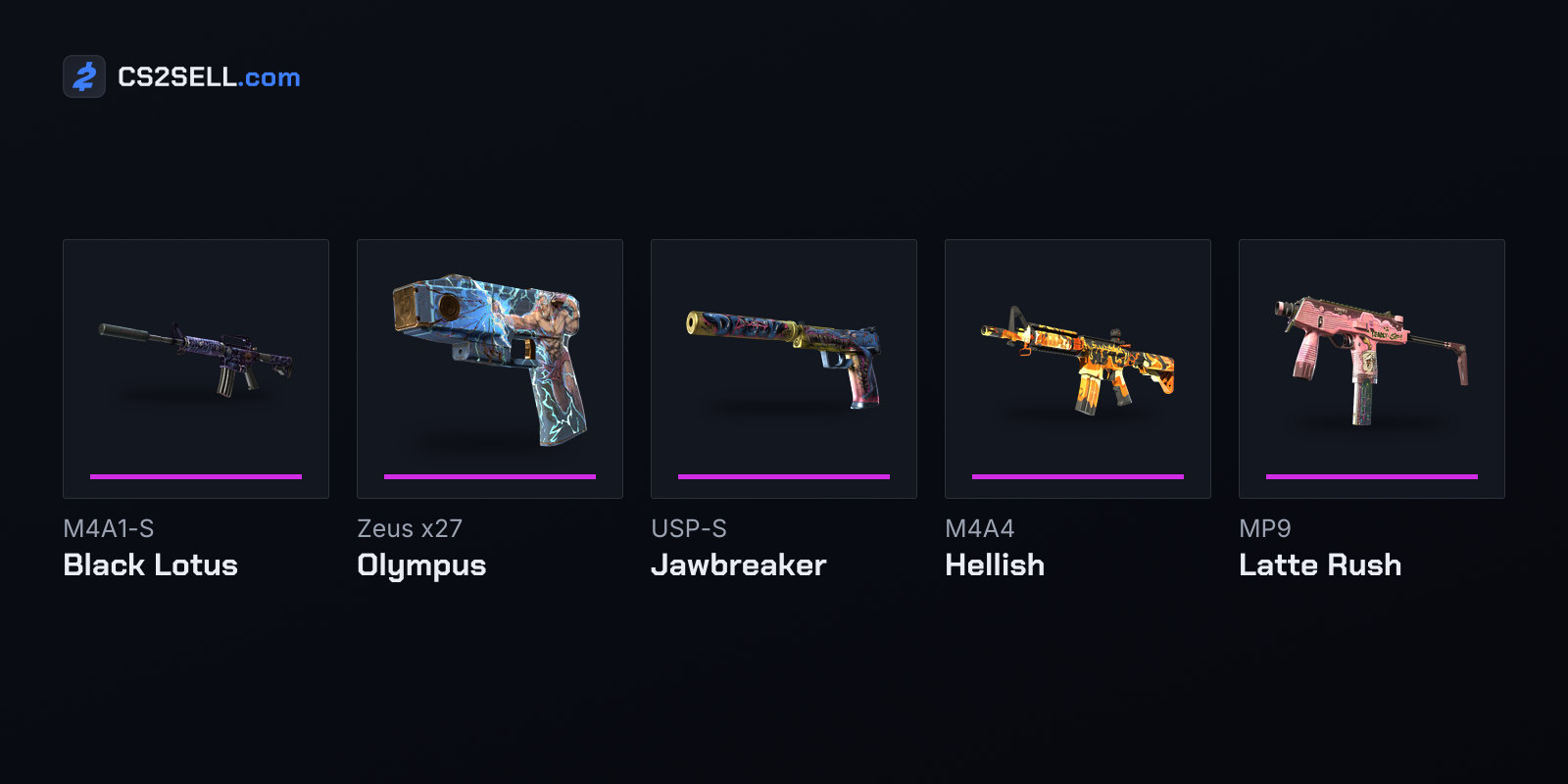
The last column is the rule an old CS:GO trade up calculator may still use. There, each input added one ticket for every possible result in its collection: 7 × 3 tickets for Kilowatt and 3 × 2 for Train 2025, 27 in all. slyk's video shows the gap with five CZ75-Auto | Yellow Jacket from the Falchion Collection and five MAC-10 | Hot Snakes from the Havoc Collection: the old rule gave all three Coverts 33%, while the current one gives the AK-47 | X-Ray 50% and the two Falchion Coverts 25% each. If your calculator's numbers match the old column, it predates the change.
Step 2: the output float formula
The float method changed at the same time. Testers found that each input is first placed within its own finish's range:
- Position of each input = (float − minimum) ÷ (maximum − minimum).
- Average the positions over all inputs, ten or five.
- Result float = output minimum + average × (output maximum − output minimum), worked out separately for every possible result.
Then read the wear: Factory New below 0.07, Minimal Wear to 0.15, Field-Tested to 0.38, Well-Worn to 0.45, Battle-Scarred above. Valve's Workshop guide rounds the middle two to 0.37 and 0.44, which our float guide explains along with float caps.
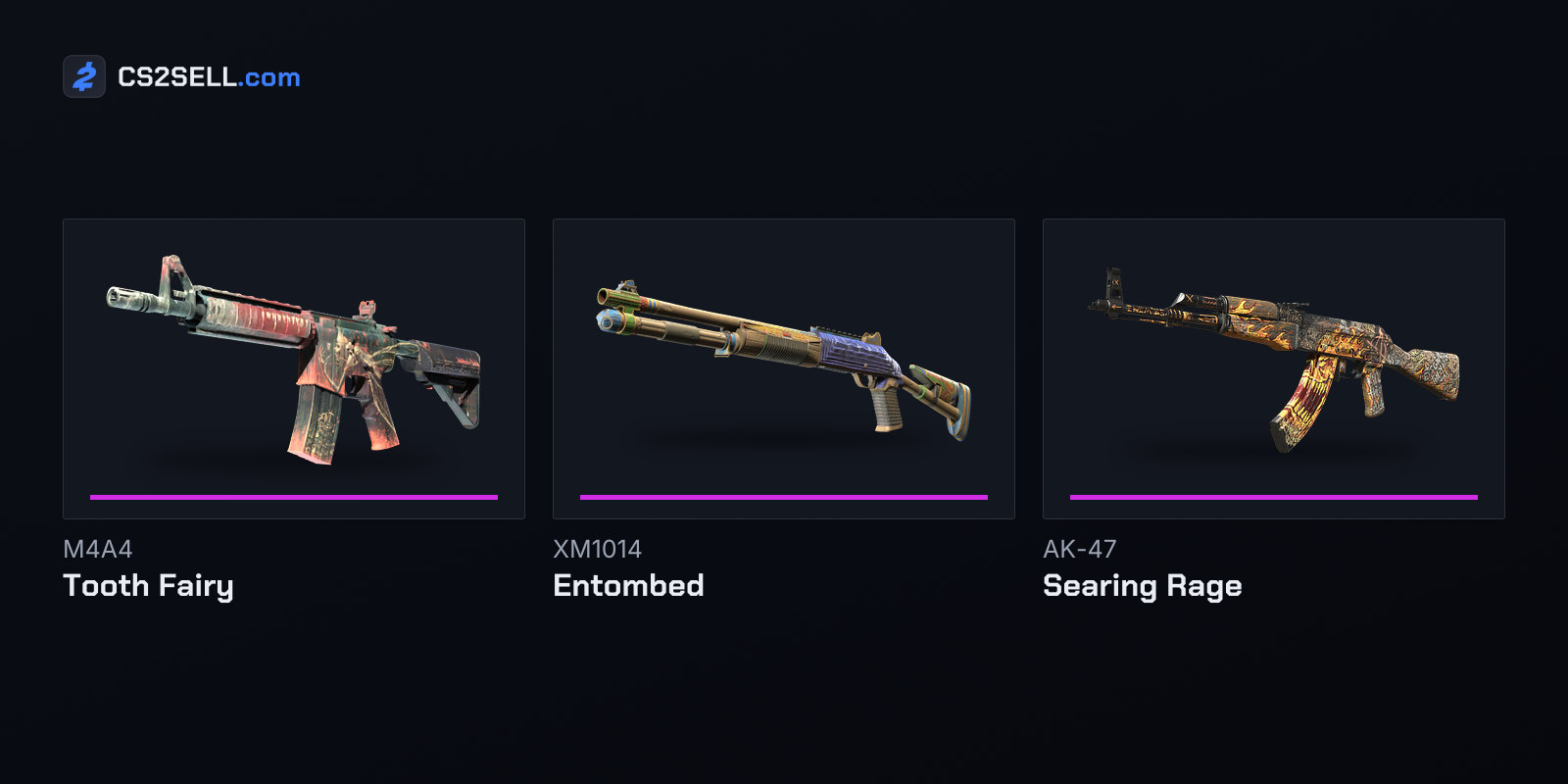
Worked example 2. Five Galil AR | Connexion from The Fracture Collection, range 0.00 to 0.80, each at 0.064, so each sits at position 0.08. Five Nova | Rising Sun from the Fever Collection, range 0.00 to 1.00, each at 0.068, position 0.068. The average position is 0.074, and each collection has a 50% chance shared by its three Classifieds.
| Possible result | Range | Result float | Wear |
|---|---|---|---|
| M4A4 Tooth Fairy | 0.00–0.73 | 0.0540 | Factory New |
| Glock-18 Vogue | 0.00–0.75 | 0.0555 | Factory New |
| XM1014 Entombed | 0.00–0.50 | 0.0370 | Factory New |
| AK-47 Searing Rage | 0.00–1.00 | 0.0740 | Minimal Wear |
| Glock-18 Shinobu | 0.00–1.00 | 0.0740 | Minimal Wear |
| UMP-45 K.O. Factory | 0.00–1.00 | 0.0740 | Minimal Wear |
The older formula, still shown on the Counter-Strike Wiki, averaged the raw floats instead. Here that gives 0.066, and all three Fever results would have come out Factory New. A capped input counts for more than its float suggests, so check every input's range, not just its number.
Knife and glove trade-ups
The five-Covert contract follows the same two steps, with 20% per input. The pool is the case's rare special item, which Valve's English text names for single-knife cases: the Kilowatt Case promises "an Exceedingly Rare Kukri Knife", the Falchion Case a Falchion Knife.
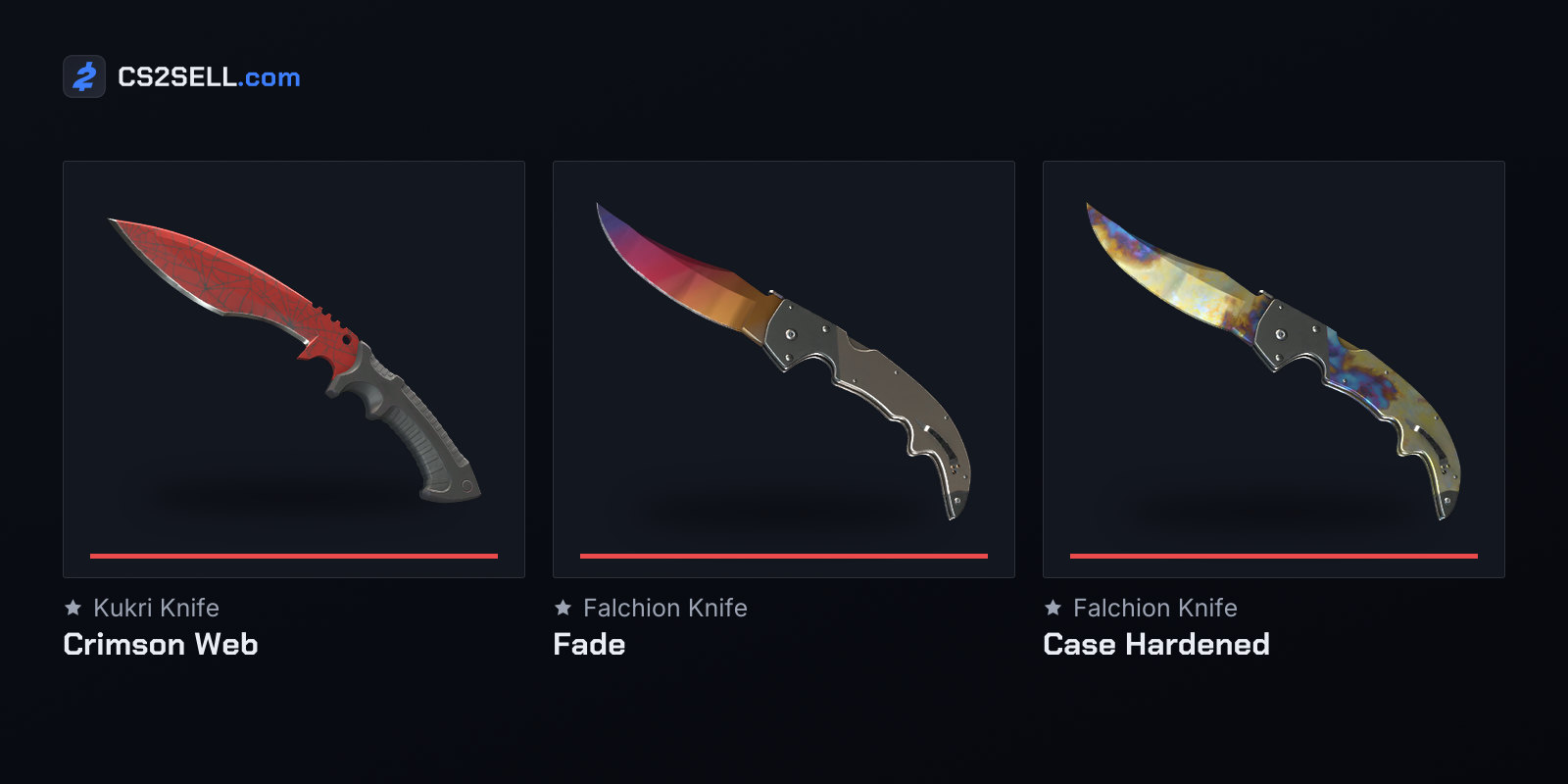
Worked example 3. Three AWP | Chrome Cannon from Kilowatt and two AWP | Hyper Beast from The Falchion Collection, all with full 0.00 to 1.00 ranges and all at 0.10. That makes 60% for a Kukri Knife, 40% for a Falchion Knife, and an average position of 0.10.
| If the finish is | Range | Result float | Wear |
|---|---|---|---|
| Fade | 0.00–0.08 | 0.008 | Factory New |
| Case Hardened | 0.00–1.00 | 0.100 | Minimal Wear |
| Crimson Web | 0.06–0.80 | 0.134 | Minimal Wear |
Valve hasn't said how the finish is picked within a pool, so treat any calculator's per-finish chances as an assumption. StatTrak contracts can only return knives, and Coverts from collections without a knife or glove pool, such as map collections, can't be used. Our article on the October 2025 knife trade-ups covers the update itself.
Checks before you sign
- Take float ranges from items_game.txt, not from a listing title or a guess from the wears a skin comes in.
- Work out every result's float, not only the one you want.
- Count inputs per collection again after any swap, because each one moves the odds by a tenth or a fifth.
- Keep StatTrak and normal skins apart, and remember that a Souvenir input loses its Souvenir status.
Sources
- Counter-Strike 2 Update, October 22, 2025 — Counter-Strike 2
- Counter-Strike 2 Update, May 22, 2026 — Counter-Strike 2
- Trade Up Contract — Counter-Strike Wiki
- Weapon Finishes Guide — counter-strike.net
- Trade ups and Floats Guide for CS2 — Steam Community
- CS2 Trade Ups (New Odds and Floats), slyk — YouTube
- items_game.txt, CS2 item definitions — GameTracking-CS2 on GitHub
- csgo_english.txt, CS2 English text — GameTracking-CS2 on GitHub