Counter-Strike 2 has two ranked modes, and they measure you in different ways. Premier gives you one visible number, the CS Rating, earned across the whole Active Duty map pool. Competitive gives you a separate Skill Group for each map you play, using the familiar ranks from Silver to Global Elite.
At a glance
| Premier | Competitive | |
|---|---|---|
| Your rank | CS Rating, a number starting at 1,000 | A Skill Group per map, from Silver I to Global Elite |
| Maps | Active Duty only; teams pick, then one is drawn at random | You tick the maps you want to queue for |
| When your rank appears | After 10 wins, again each season | After 2 wins on that map |
| Seasons and medals | Yes | No |
| Leaderboards | Friends, world and regional | No |
| Who can play | Prime accounts at Profile Level 10 or higher | Everyone; Skill Groups need Prime |
Valve's Prime FAQ sets the entry rules: free accounts can play every mode except Premier, and only Prime accounts receive Skill Groups or a CS Rating. Our guide to Prime Status explains why the Level 10 requirement means buying Prime first.
Premier and the CS Rating
Valve introduced the CS Rating in August 2023, during CS2's Limited Test, as "a visible measurement of your Counter-Strike performance" that decides where you stand on global and regional leaderboards. It called Premier "our Active Duty Pick-Ban competitive mode." Season One then started with the game's launch, as our launch article recounts.
The pick-ban part changed on September 22, 2026. Instead of banning down to one map, each team now votes to pick two maps, and one of the four is drawn at random. Valve's reasoning was that if you spend time developing strategies on a map, "you should have a chance to benefit from that investment." Our Rush Hour article covers the change. The pool itself is Ancient, Anubis, Cache, Dust II, Inferno, Mirage and Nuke, set when Season Five began in July 2026.
The rating starts at 1,000 and has no published ceiling. Valve's posts don't list the colour bands, but the Counter-Strike Wiki gives seven:
| CS Rating | Colour |
|---|---|
| 1,000–4,999 | Grey |
| 5,000–9,999 | Light blue |
| 10,000–14,999 | Blue |
| 15,000–19,999 | Purple |
| 20,000–24,999 | Pink |
| 25,000–29,999 | Red |
| 30,000 and above | Yellow |
According to the wiki, a match that could carry you across one of those 5,000-point lines becomes a promotion match, and the reverse is a relegation match. It also reports that an unused rating is hidden after a period of inactivity and comes back after one more win.
Some things outside your own play move the number too. CS2's launch notes said that when a party member is convicted of cheating and permanently banned, their associates lose CS Rating. Valve's cooldown page says players disconnected by VACnet for irregular gameplay, and anyone partied with them, have their rating adjusted. A November 2023 patch added an end-of-match notice for mid-match adjustments, such as recovering points lost against a cheater.
Seasons, medals and leaderboards
Premier runs in seasons. When a new one starts, your rating is hidden until you win ten matches; for Season Two, Valve also recalibrated everyone's rating based on the previous season. Season One ran from September 2023 to January 2025, followed by Season Two, Season Three in July 2025, Season Four in January 2026 and Season Five, which is still running.
Each season ends with a medal. Since Season Two you need an account in good standing, 25 Premier wins and an active rating when the season closes. The medal's colour matches the highest rating you reached, and its bars count your wins, one per 25, up to five.
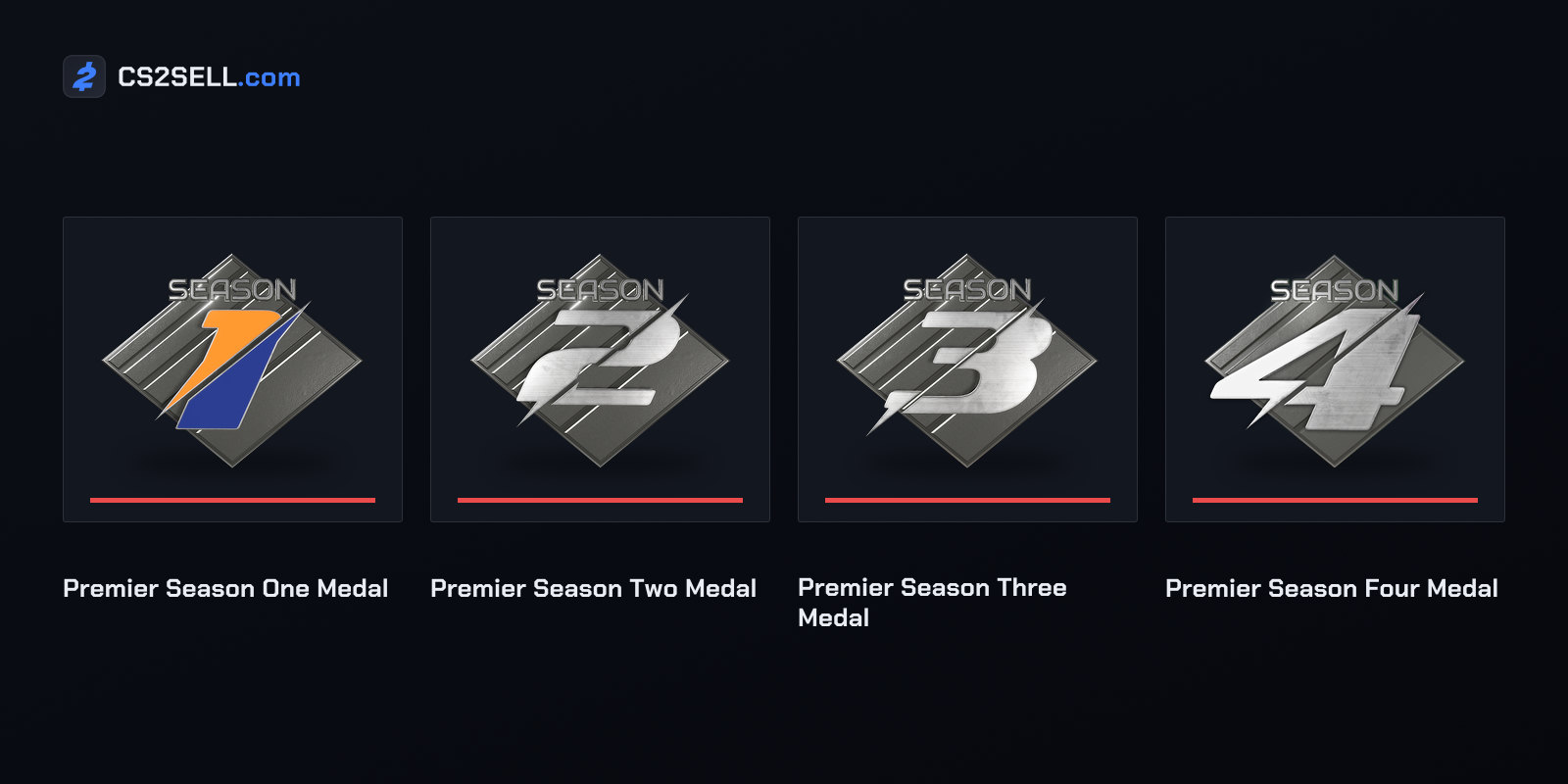
Valve's leaderboard FAQ lists nine boards: Friends, World, and seven regions (Africa, Asia, Australia, China, Europe, North America and South America). You can't choose your region; it's set by the location of the servers you play on most. Leaderboard names are reviewed by moderators and locked for the rest of the season once approved.
Competitive and per-map Skill Groups
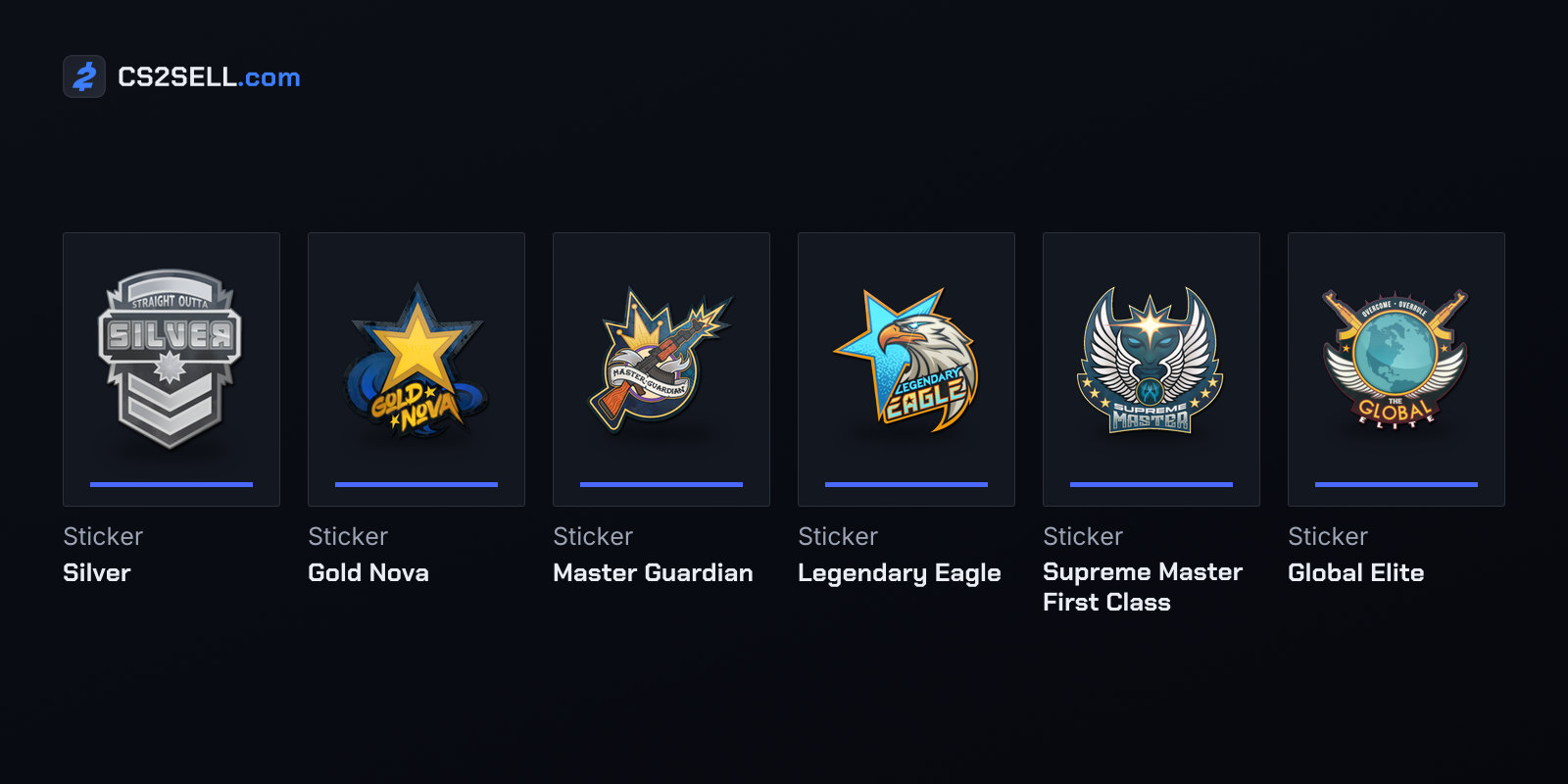
Competitive keeps CS:GO's 18 Skill Groups, from Silver I to The Global Elite. The difference in CS2 is that each map has its own. The Counter-Strike Wiki's example is a player who is Silver III on Mirage and Master Guardian I on Nuke at the same time.
A map's Skill Group appears once you have won two matches on it, a rule Valve introduced in the June 2024 update. The wiki adds that a group is hidden again if you don't play that map in Competitive for 28 days, and returns after another win or draw there. In January 2026 Valve adjusted the underlying rank values and expired everyone's per-map groups, which then had to be earned again.
You also control the maps. Competitive lets you tick the maps you want to queue for, with the Active Duty group selected by default and Reserve maps available too.
Which one to play
The modes suit different goals. Premier rewards being solid across the Active Duty pool, since you only control part of the map draw, gives you one number to compare with friends and the leaderboards, and pays out a medal each season. Competitive is the better place to learn or grind a single map, including ones outside the Active Duty pool, without your result on one map affecting another.
The same discipline applies to both. Competitive cooldown rules also cover Premier, so abandoning a match, kicking too many teammates or collecting griefing reports can keep you out of either mode for a while.
Sources
- Your Time is Now — Counter-Strike 2
- Seasons Change — Counter-Strike 2
- Rush Hour — Counter-Strike 2
- Counter-Strike 2 Leaderboards — Steam Support
- CS2 - Prime Status and Free to Play — Steam Support
- CS2 - Competitive cooldowns and bans — Steam Support
- Premier — Counter-Strike Wiki
- Competitive — Counter-Strike Wiki