CS:GO ranks are the 18 Competitive Skill Groups, from Silver I at the bottom to The Global Elite at the top. Valve added them to Counter-Strike: Global Offensive in October 2012, and Counter-Strike 2 still uses the same ladder in Competitive and Wingman. Premier is the exception: it ranks you with a CS Rating, which our Premier and CS Rating guide explains.
CS:GO ranks in order
The game's own text files list the Skill Groups in this order. The short forms are the ones players use in chat and guides:
| # | Skill Group | Short form |
|---|---|---|
| 1 | Silver I | S1 |
| 2 | Silver II | S2 |
| 3 | Silver III | S3 |
| 4 | Silver IV | S4 |
| 5 | Silver Elite | SE |
| 6 | Silver Elite Master | SEM |
| 7 | Gold Nova I | GN1 |
| 8 | Gold Nova II | GN2 |
| 9 | Gold Nova III | GN3 |
| 10 | Gold Nova Master | GNM |
| 11 | Master Guardian I | MG1 |
| 12 | Master Guardian II | MG2 |
| 13 | Master Guardian Elite | MGE |
| 14 | Distinguished Master Guardian | DMG |
| 15 | Legendary Eagle | LE |
| 16 | Legendary Eagle Master | LEM |
| 17 | Supreme Master First Class | SMFC |
| 18 | The Global Elite | GE |
The names fall into families: six Silver ranks, four Gold Nova ranks, four Guardian ranks, two Eagles, then Supreme and Global Elite on their own. The top rank's official name includes "The", though almost everyone drops it.
How the CS:GO ranking system worked
Skill Groups arrived in an update on October 25, 2012, and Valve explained them a few days later in a short FAQ. "Like an Elo rating in Chess," it wrote, the groups "predict how well players will perform when playing against other players." Your badge stayed hidden until you had won 10 competitive matches, which Valve said gave it enough data to place you with confidence.
The same FAQ answered a worry that never went away: should you avoid queueing with weaker friends? Valve said no. The matchmaker accounts for the lower-ranked player, and the system predicts how each team member should perform, so losing with a weaker teammate is "not likely to significantly impact" your Skill Group.
The number behind the badge was never shown. PC Gamer reported that a Valve employee said in 2015 that matchmaking was first based on Glicko-2, a chess-style rating that also tracks how certain it is about each player, and had since been heavily modified. Another Valve employee, replying to a player's guide, wrote: "All computations are performed on our matchmaking backend." Valve never confirmed the player theories that MVPs or round margins move your rank.
Several rules grew around the ladder over the years:
- Placement limits. From November 21, 2014, accounts without a Skill Group could win only two Competitive matches a day and couldn't party with players of a very high Skill Group. Parties with a very wide spread of groups couldn't queue unless they were a full five. PC Gamer's 2021 guide put that spread at five ranks either way.
- Inactivity. A Skill Group was hidden after 28 days without Competitive matches, according to the Counter-Strike Wiki, and returned after a win or a draw.
- Cheaters. From June 2014, when a player was banned for cheating through VAC or Overwatch, the Skill Group changes from their recent wins were reverted for their party and their opponents.
- Prime only. On June 3, 2021, free accounts stopped earning Skill Groups and moved to a new Unranked queue, while ranked matches became Prime-only. Our Prime Status guide covers what that means today.
- The 2022 recalibration. On August 1, 2022, Valve recalibrated every player. Groups stayed hidden until the next win, and Valve warned that "most of you will notice a change."
CS:GO also had a separate 15-step ladder for Danger Zone, its battle royale mode, running from Lab Rat I to The Howling Alpha.
CS:GO rank distribution
The distribution charts that circulate don't come from Valve. They're built by independent statistics sites from samples of matches. In January 2021, PC Gamer reported one such monthly sample: about 34 percent of players sat in the Gold Nova ranks, and Legendary Eagle and above made up roughly the top 10 percent.
PC Gamer added a caveat. Higher-ranked players tend to play more, so a sample of matches over-represents them. Those figures also predate both the 2022 recalibration and CS2's per-map system, so read them as a snapshot of CS:GO in early 2021, not a guide to where you stand now.
What carried into CS2's Competitive
CS2 kept the 18 names and badges, and they still need Prime: Valve's Prime FAQ says Competitive Skill Groups and CS Ratings are "only issued to users with Prime Status." The big change is that each map now has its own group. The Premier guide linked above covers those per-map rules in detail; here is how they compare with CS:GO's ranking system:
| CS:GO | CS2 Competitive | |
|---|---|---|
| Skill Groups | One for all maps | One for each map |
| Wins before your group shows | 10 | 2 on that map, since June 25, 2024 |
| Inactivity | Hidden after 28 days without Competitive | Hidden for a map after 28 days off it |
| Who earns one | Prime accounts, since June 2021 | Prime accounts |
| Valve-wide resets | Recalibration, August 2022 | Redistribution, June 2024; expiry, January 2026 |
The June 2024 update did more than lower the wins needed. Valve said it had redistributed players across the Skill Groups while making the badges easier to earn. On January 21, 2026, it adjusted the underlying per-map rank values and expired every per-map group until players won the required matches again. None of Valve's announcements since then, up to October 22, 2026, has changed the system.
Wingman keeps a ladder too. It uses the same 18 names but gives you one Skill Group for the whole mode rather than one per map, as our Wingman ranks guide explains.
Rank emblems as stickers and patches
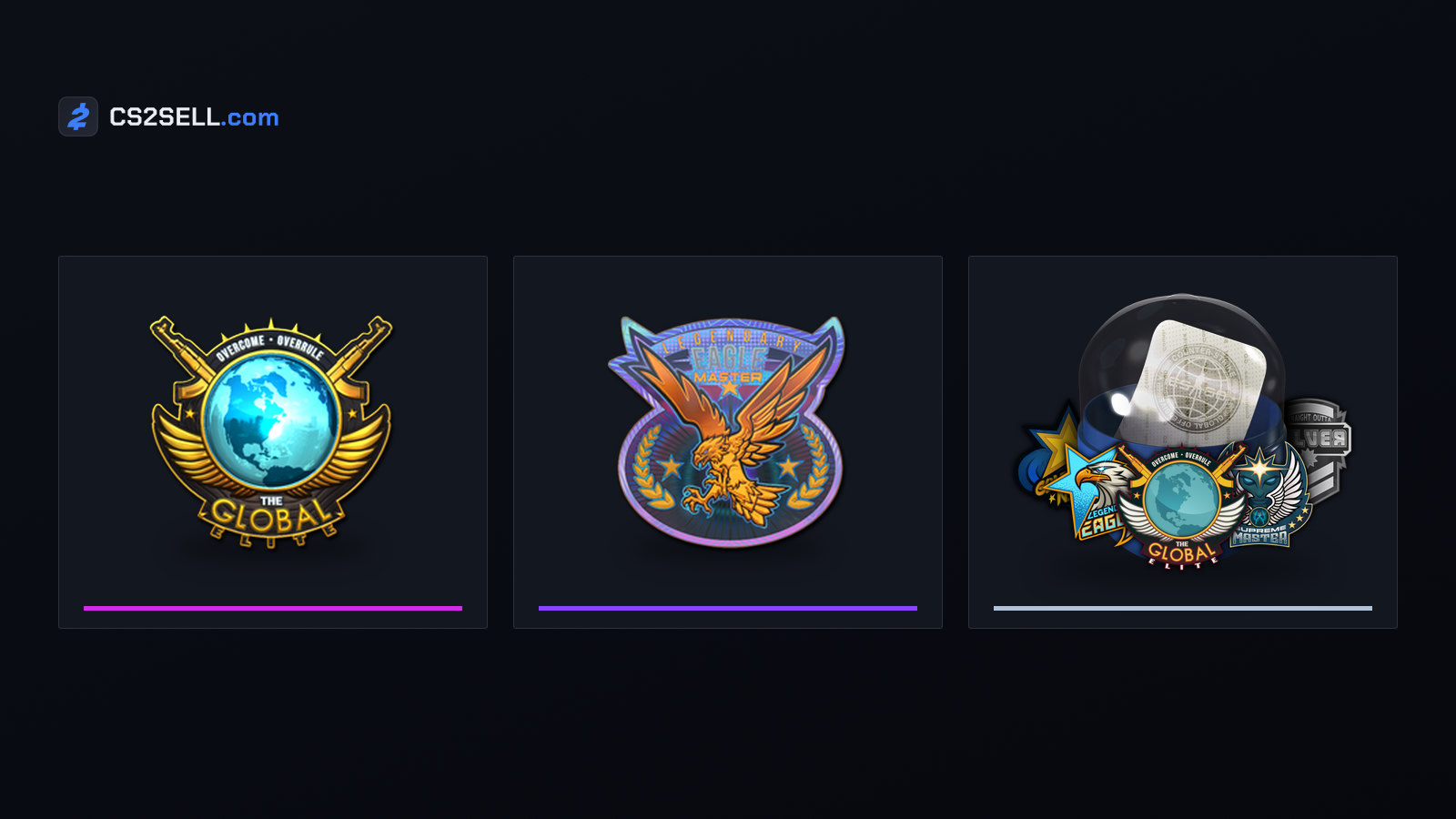
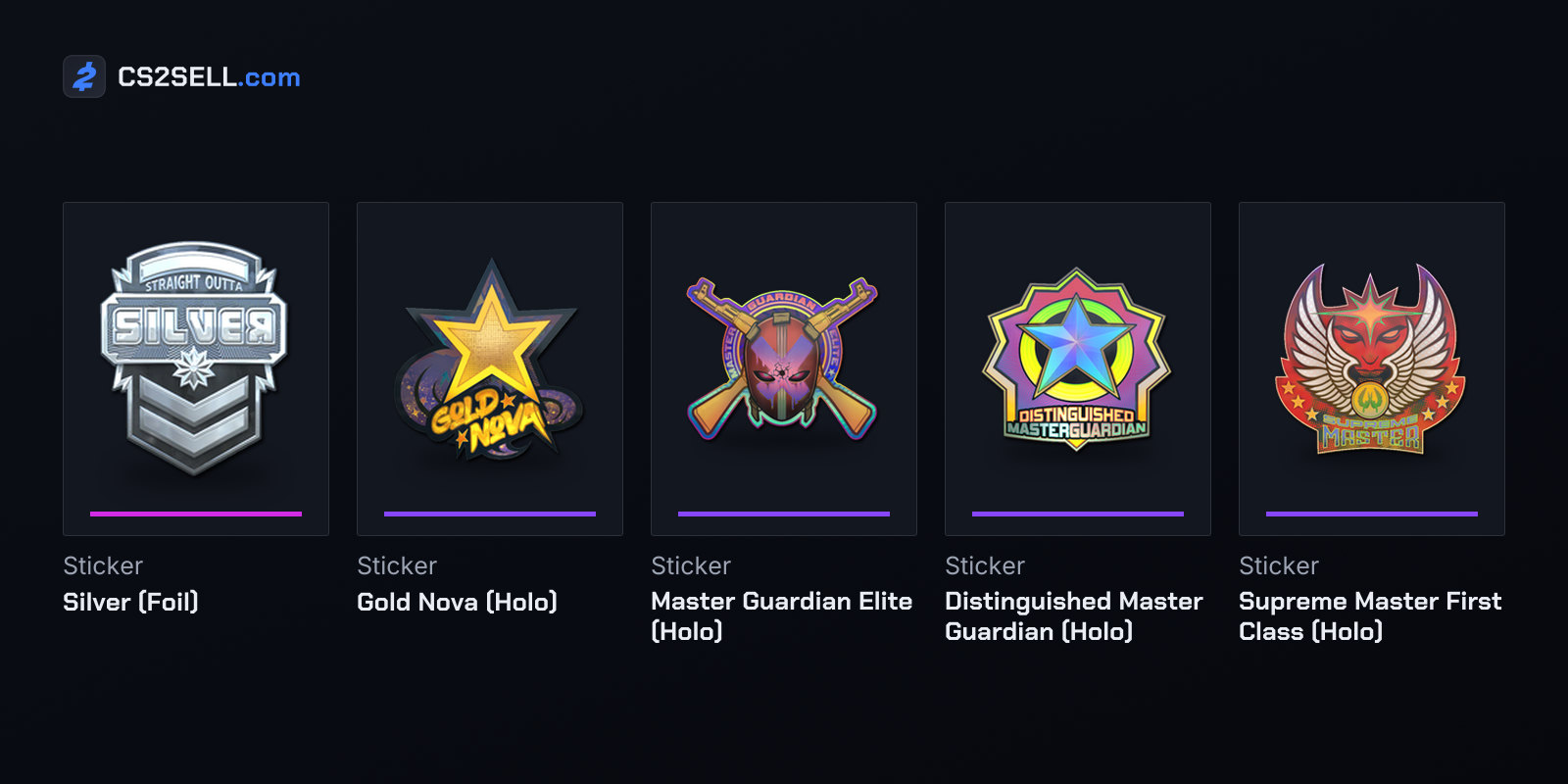
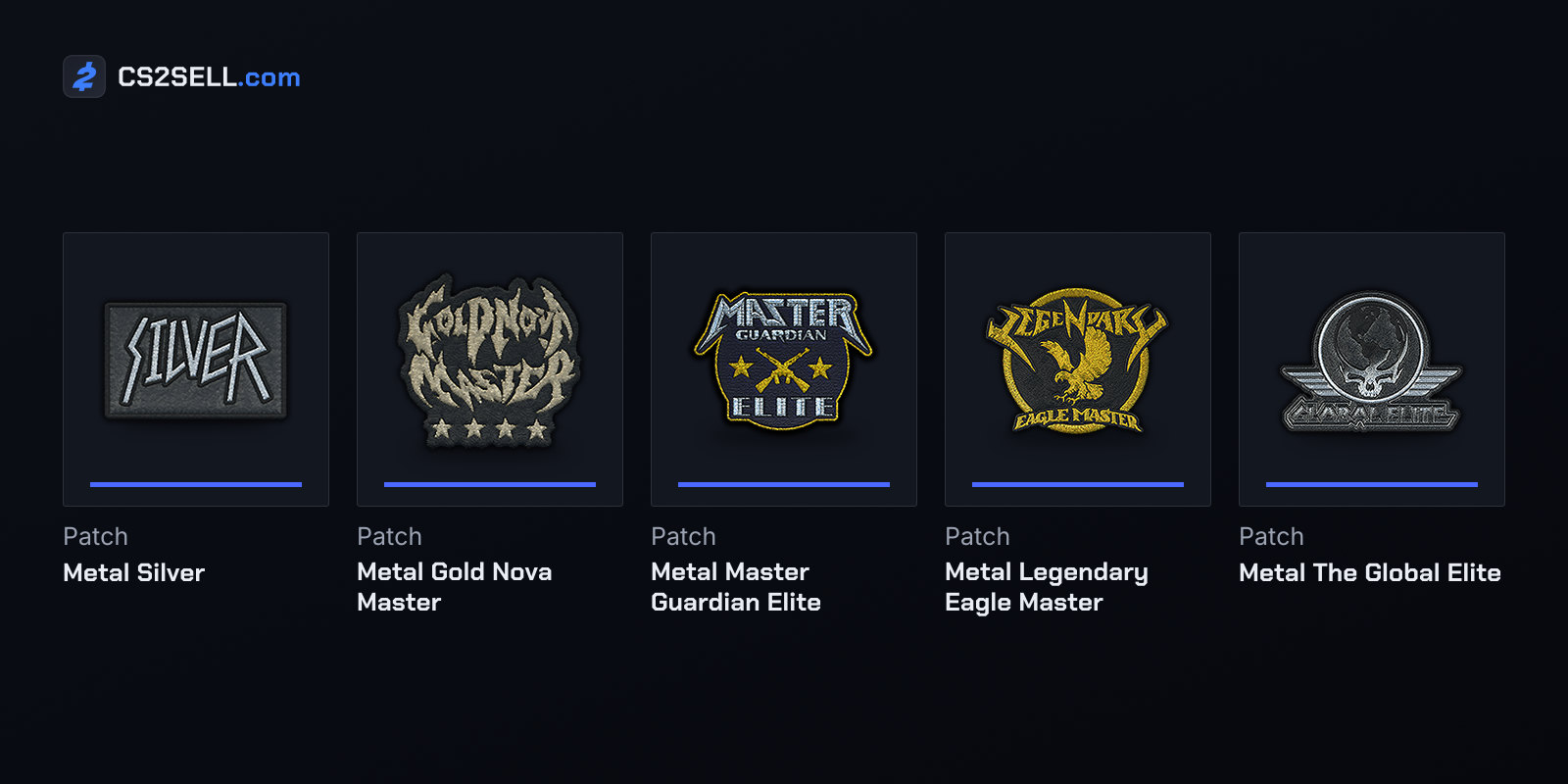
The badges also exist as items. The Skill Groups Capsule turned nine of the emblems, from Silver to Global Elite, into stickers by community artist daniDem, each in a standard version and a Holo or Foil one. The Metal Skill Group Patch Collection did the same in embroidered form. Valve's item text says those patches "can be applied to any agent you own," and our guide to agents and patches explains how that works.
Sources
- Competitive Skill Groups FAQ — Counter-Strike blog
- Matchmaking Update (August 1, 2022) — Counter-Strike blog
- Release Notes for 6/25/2024 — Counter-Strike 2 news
- Counter-Strike 2 Update (January 21, 2026) — Counter-Strike 2 news
- CS2 - Prime Status and Free to Play — Steam Support
- CS:GO ranks and how they work — PC Gamer
- Competitive — Counter-Strike Wiki
- csgo_english.txt (CS2 game files) — SteamTracking GameTracking-CS2 on GitHub