Liquidity is how quickly you can turn an item into money without cutting its price much. A weekly-drop case can be sold almost the moment you decide to, while a rare knife with a special pattern might wait weeks or months for the right buyer. Knowing where an item sits on that scale tells you how much a quoted price is really worth to you.
Two parts: speed and the discount
Liquidity has two sides that move together. One is time: how long it takes to find a buyer at a fair price. The other is the price cut you accept if you won't wait, which shows up as the spread between the highest buy order and the lowest listing.
In finance, that spread is a standard way to measure the cost of trading without delay. The same logic applies to skins. On a liquid item the best bid sits just under the best ask, so selling instantly costs you very little. On an illiquid one the gap is wide, and an urgent seller pays for the hurry.
What makes an item liquid
Identical copies. Cases, sticker capsules and other containers are interchangeable: any copy is as good as another. Steam calls these commodity items, where buyers place an order and an item is picked for them. Because every copy matches every buy order, sellers can nearly always find a bid.
A large base of buyers. Cheaper items are within reach of more players, and skins for weapons people buy every round reach more potential owners than those for guns they rarely pick. More potential buyers means more bids at any moment.
Steady supply and turnover. Items still in the weekly drop pool keep arriving, so lots of people hold them and lots of people sell them. That constant flow keeps prices continuous and spreads tight.
Uniqueness works the other way. Float, pattern and sticker combinations make each copy different, and a different copy needs a buyer who values that specific difference. The more an item's price depends on details, the fewer people are shopping for exactly that.
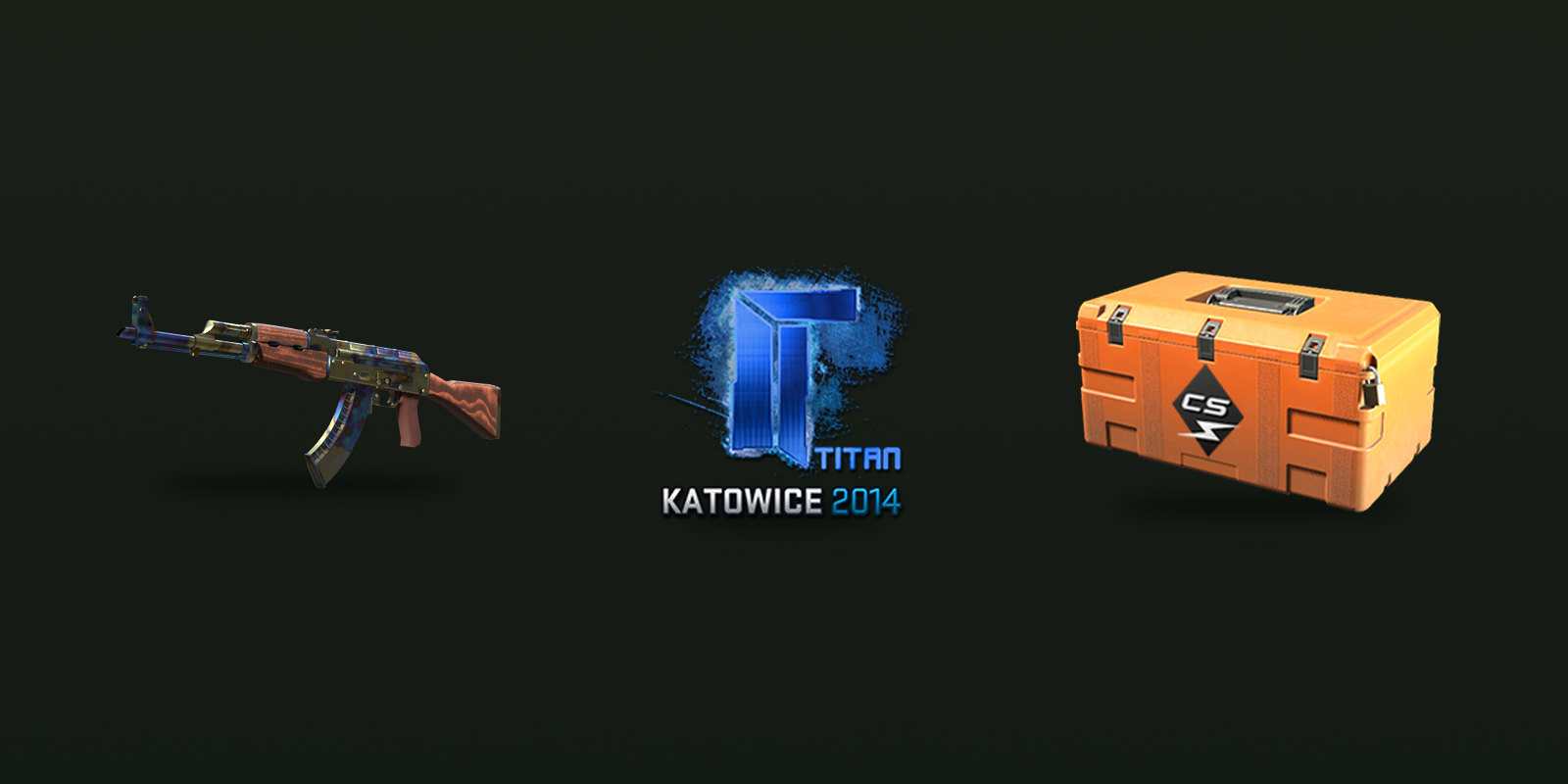
The extreme case shows how slow this can be. Dexerto reported in April 2023 that a StatTrak Minimal Wear AK-47 | Case Hardened with the top blue-gem pattern and four Katowice 2014 Titan Holo stickers sold for around $400,000, and that it had been put up for sale in November 2022. Even for a famous item, finding a buyer took about five months.
Rules that slow items down
Some limits on liquidity come from Steam itself rather than from demand.
| Rule | Effect on liquidity |
|---|---|
| Single Steam listing capped at $1,800 | Expensive items can't sell on Steam at all |
| Steam wallet capped at $2,000 | Sellers near the cap can't list more |
| Wallet funds can't be withdrawn | Money from Steam sales stays on Steam |
| Seven-day trade protection | Traded items can't move again for a week |
| Seven-day restriction on store and market items | Fresh purchases can't be resold straight away |
The listing cap matters most at the top end. A knife or glove pair worth more than the cap has no Steam order book, so its owner depends on third-party marketplaces or direct trades with other players, where there are fewer buyers and every deal takes longer to arrange.
Steam's trade protection delivers traded CS2 items immediately but keeps them from being traded, consumed or modified for seven days, and within that window the trade can be reversed. Since Valve's October 2024 patch, items from the in-game store and the Steam Market also carry a seven-day re-trade and re-sale restriction. For anyone flipping items, that means a week of waiting between buying and selling, which ties up money and adds price risk. Details are in Steam's trade protection explained.
Liquid on Steam is also not the same as liquid in cash. Money from a Steam Market sale lands in a Steam wallet and can only be spent on Steam, so an item that sells in seconds there may still take time to turn into money you can withdraw.
How to gauge liquidity before you buy
You can estimate liquidity from what the market shows you:
- Volume. Steam's charts now show sales volume next to price. Many sales per day means you can sell without waiting.
- Listings against sales. Hundreds of listings and a trickle of sales means sellers are queuing for scarce buyers.
- Spread. Compare the highest buy order with the lowest listing. A small gap points to an active market.
- Behaviour under stress. Check what the price did around big updates. Thin markets often jump between levels instead of moving smoothly.
Steam's market search can also sort items by popularity and quantity, which gives a quick feel for what trades heavily and what doesn't.
Liquidity changes over time
An item's liquidity isn't fixed. A case leaving the drop pool stops getting new copies, so over time fewer people hold it and fewer sell it. A rule change can do it overnight: after Valve's October 2025 update made five Covert skins tradable up into a knife or gloves, ordinary Coverts gained a whole new group of buyers almost immediately.
If you know you may need to sell quickly, factor liquidity into what you buy. A slightly cheaper item that takes a month to sell can cost you more than a liquid one with a thin spread. When speed matters more than squeezing out the last dollar, Sell lets you sell items instantly to CS2Sell's bots, and for slower items you can list them for other users there instead. The trade-off between the two is covered in instant sell vs listing.
Sources
- Community Market FAQ — Steam Support
- Trade Protected Items — Steam Support
- Bid–ask spread — Wikipedia
- AK-47 CSGO skin & knife sell for $500,000 as Counter-Strike skins explode in price — Dexerto
- Counter-Strike 2 patches/October 2, 2024 — Counter-Strike Wiki
- Steam Community Market Updates — Steam News (Valve)