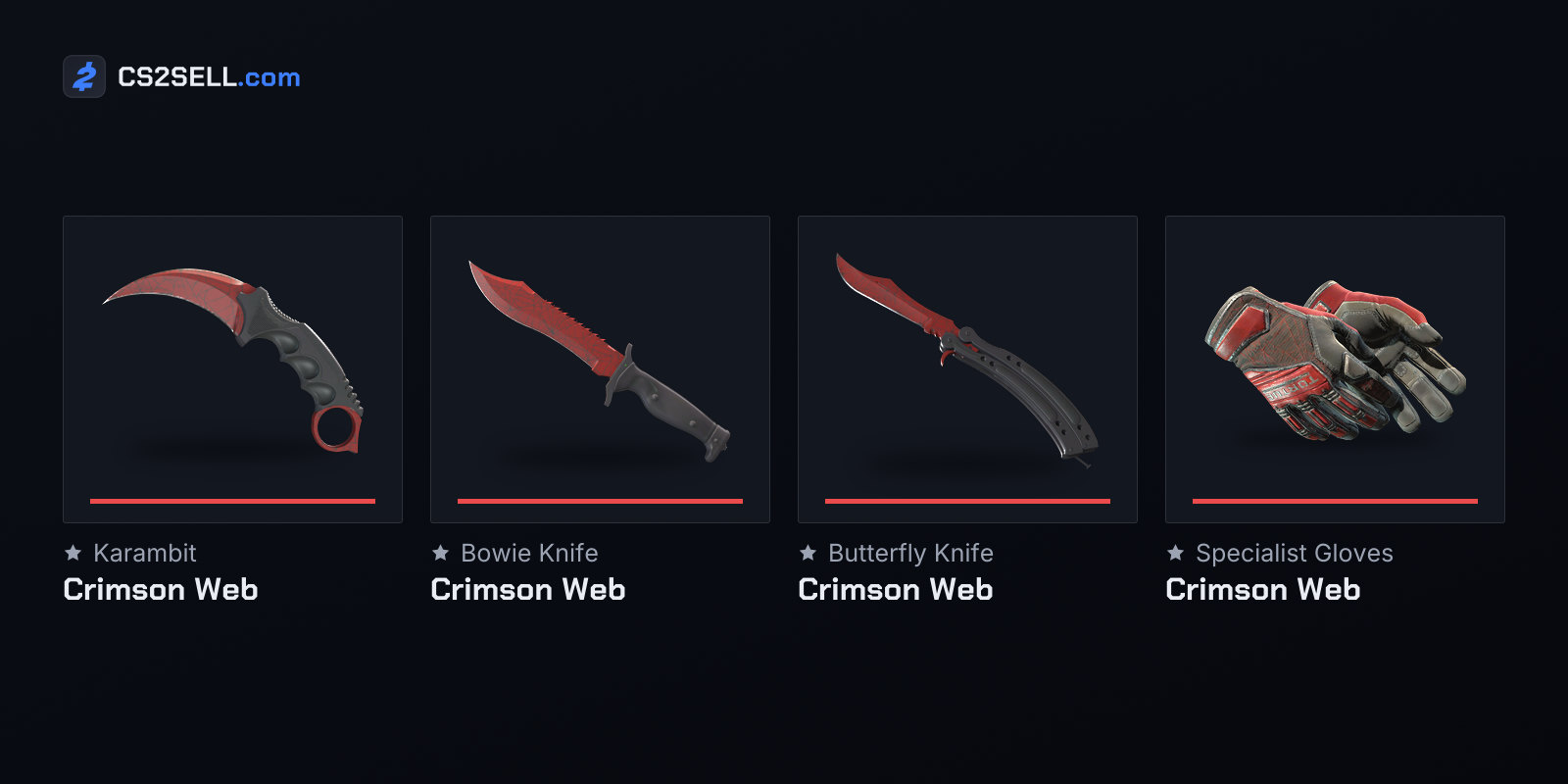
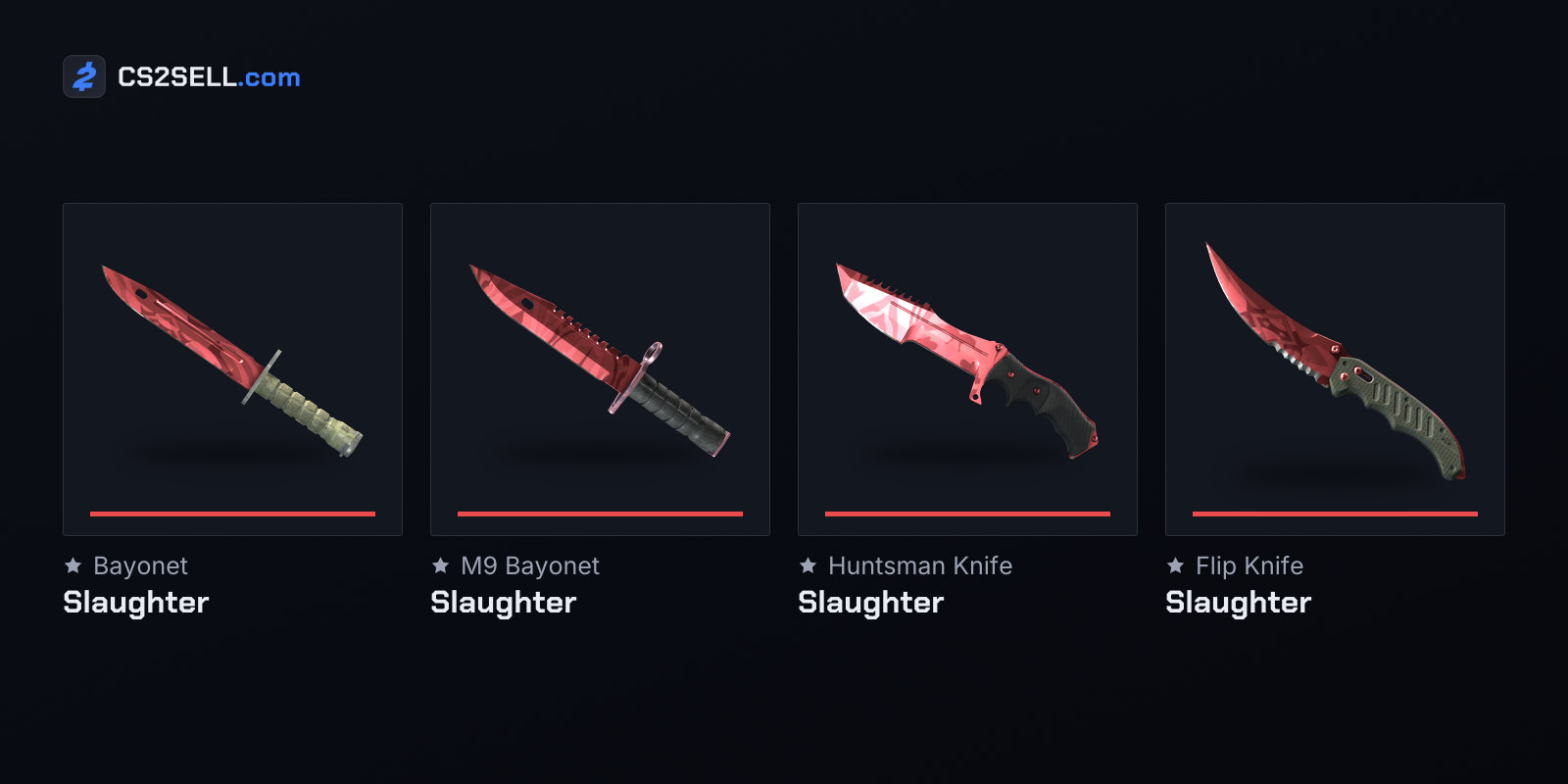
Crimson Web and Slaughter are two of the oldest knife finishes in Counter-Strike, and both are pattern skins: the paint seed decides what ends up on the blade. On Crimson Web, collectors count the webs. On Slaughter, they look for shapes with names like diamond, angel and heart. Neither scale comes from Valve, so it helps to know how the conventions work before paying for one.
Two finishes from the first knife cases
Both finishes go back to the Arms Deal update of August 2013. A guide to that update published by the Russian site Igrovoy Effekt on August 21, 2013 lists the twelve finishes the five original knives could roll, and Crimson Web and Slaughter are both on it. The Counter-Strike Wiki's page for the CS:GO Weapon Case, the first case, includes the M9 Bayonet Crimson Web among its knives.
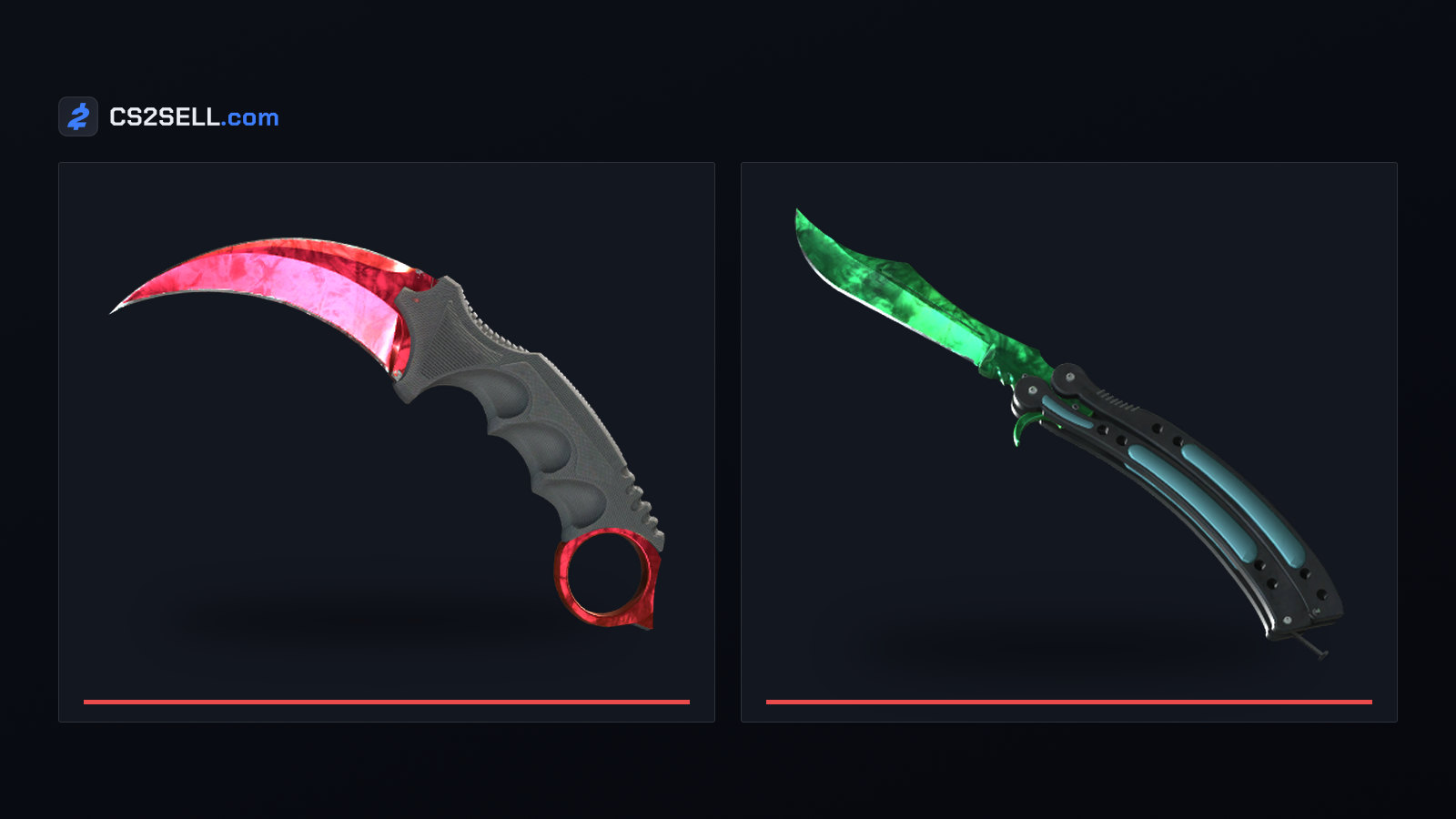
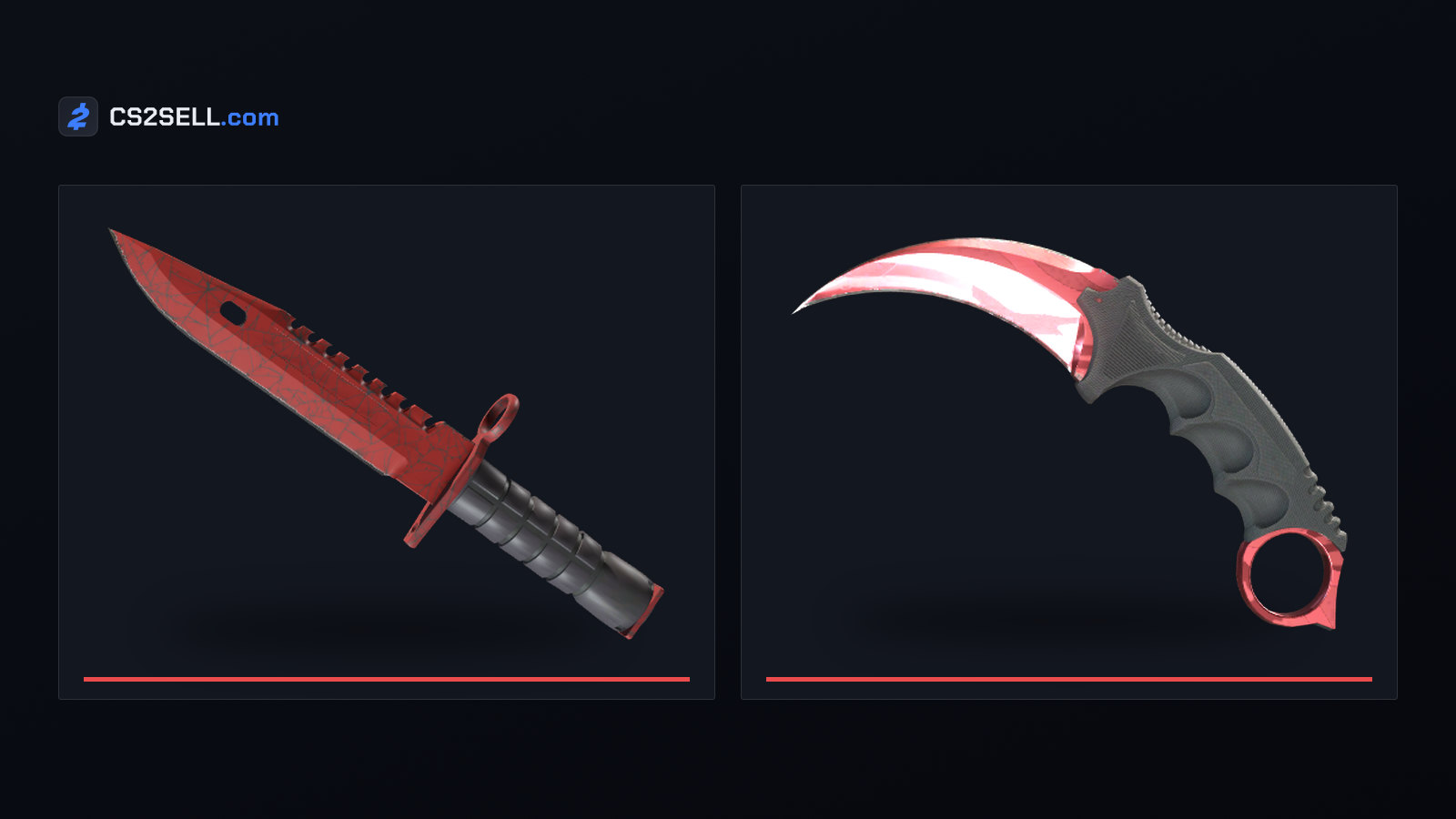
The two finishes are built differently. Valve's item files describe Crimson Web as "a spider web-patterned hydrographic over a red base coat", and give it a float range of 0.06 to 0.80, which leaves Factory New only the narrow band from 0.06 to 0.07. Slaughter is "painted in a zebra-stripe pattern with aluminum and chrome paints" and then given "a tomato red candy coat", with a float range of 0.01 to 0.26, so it only comes in Factory New, Minimal Wear and Field-Tested. Our float guide explains how those caps work.
Both are now on every one of the 20 knife models. Crimson Web also appears on four guns, the CZ75-Auto, Desert Eagle, R8 Revolver and SCAR-20, and on the Specialist Gloves.
How the seed decides the pattern
Each finish uses one large texture. The paint seed, shown in the inspect screen as the Pattern Template, picks which part of it lands on the knife, and because the texture is scaled to each model, the same seed looks different on an M9 Bayonet and a Karambit. Our pattern index guide covers the mechanism. Wear does not move the pattern; it only scratches it.
Crimson Web: counting the webs
A web, for collectors, is a centre point with threads radiating from it. The more complete webs on the play side, the side you see in first person, and the better they are centred, the more a Crimson Web is usually prized. A 2014 Steam guide to knife patterns already put it that way: three or four big webs on the play side was the rarest form, and zero or one web the common one.
Blade size decides what is possible. A pattern guide by RemIx, who went through all the seeds for two knives, gives these counts:
| M9 Bayonet | Karambit | |
|---|---|---|
| Triple webs | 45 | none listed |
| Double webs | 260 | 12 |
| Single webs | 418 | 395 |
| No mostly visible web | 276 | 593 |
The guide notes that patterns 0 and 1 are identical, so the counts are out of roughly a thousand seeds. On the M9 it ranks 718 as the best-aligned triple web, followed by 423 and 72. On the Karambit, double webs exist but the guide calls them "not very appealing" because of the small blade and large pattern scale, and it puts centred single webs at the top instead.
Both guides also warn about fake webs: partial shapes that can be mistaken for a real web at a glance.
Slaughter: diamonds, angels and hearts
On Slaughter, collectors look for recognisable shapes in the stripes. The same 2014 Steam guide ranked a full diamond as the rarest M9 Bayonet Slaughter, an angel on the front or half angels as uncommon and a zebra pattern as common. For the Karambit it named the diamond as the rarest, a half diamond or angel as uncommon and the "bone" as common.
Later guides added more names. A Steam guide to pattern skins, updated in 2026, lists hearts, diamonds, zebra stripes and a phoenix among the shapes collectors chase, plus a long-running joke pattern that looks like the Lenny face. It treats Slaughter together with Dark Water, the gun finish on the M4A1-S and USP-S, which Valve's files build from a related zebra-stripe pattern. Another widely rated guide that picks favourite seeds for every knife lists diamond picks for most models, for example 229 and 349 on the Karambit and 90, 124 and 652 on the Bayonet.
What these sources agree on is the top and the bottom: a complete, clearly visible diamond is the shape every one of them puts first, and a plain zebra layout is the baseline. Angels and half diamonds sit in between.
Why tiers are conventions, not Valve data
The game shows a Pattern Template number and nothing else. Triple webs, diamonds and angels are readings of that number by people comparing screenshots, and the guides say so. RemIx calls his rankings objective but adds that "some people may have different opinions" and advises buyers to rely on their own preferences. Seed lists also only apply to the knife they were made for, and a shape that is obvious in a flat render can be cut off by the edge of a real blade.
Rarity and appeal also differ. The Karambit's 12 double-web seeds are far rarer than its centred single webs, yet RemIx calls them not very appealing and puts the centred single webs at the top.
Checking a pattern knife before you buy
- Read the seed in game. Inspect the knife and note the Pattern Template, then compare it with a list for that exact model and finish.
- Look at the play side. Web counts and shapes are judged there.
- Count for yourself. Decide whether you see three full webs or a complete diamond, rather than trusting a title.
- Mind the float. A Factory New Crimson Web sits between 0.06 and 0.07, and Slaughter never goes past Field-Tested.
On CS2Sell, the paint seed filter on Buy lets you search Crimson Web and Slaughter listings for the pattern numbers on your list.
Sources
- ★ M9 Bayonet Crimson Web Pattern Guide — Steam Community
- ★ Karambit Crimson Web Pattern Guide — Steam Community
- Knife Price Guide — Steam Community
- A (Not So) Small Guide For Pattern Based Skins — Steam Community
- Top 3 Patterns for Every Knife in CS2 — Steam Community
- CS:GO Arms Deal Update: weapons guide — Igrovoy Effekt
- CS:GO Weapon Case — Counter-Strike Wiki
- items_game.txt — GameTracking-CS2 on GitHub