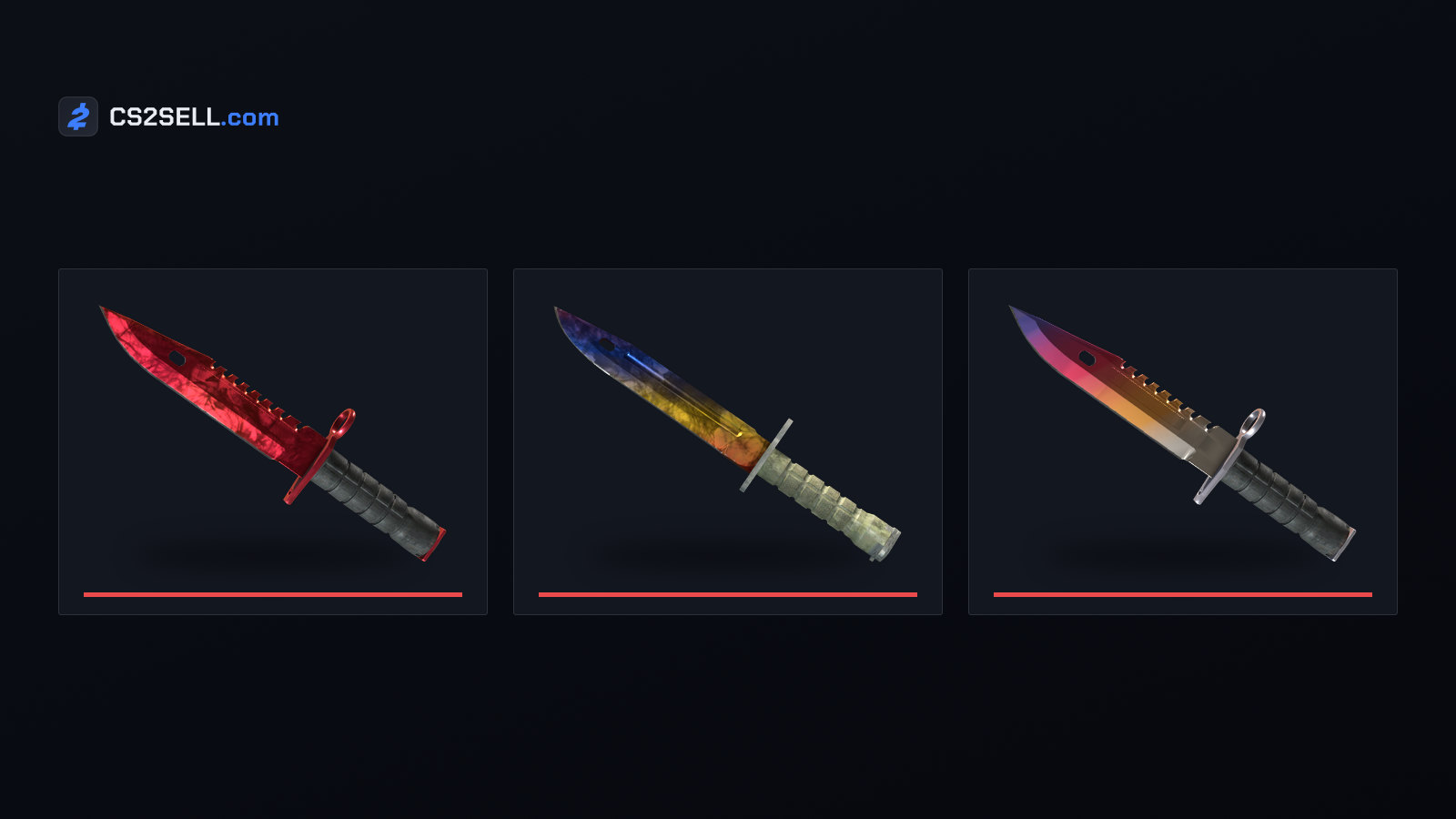
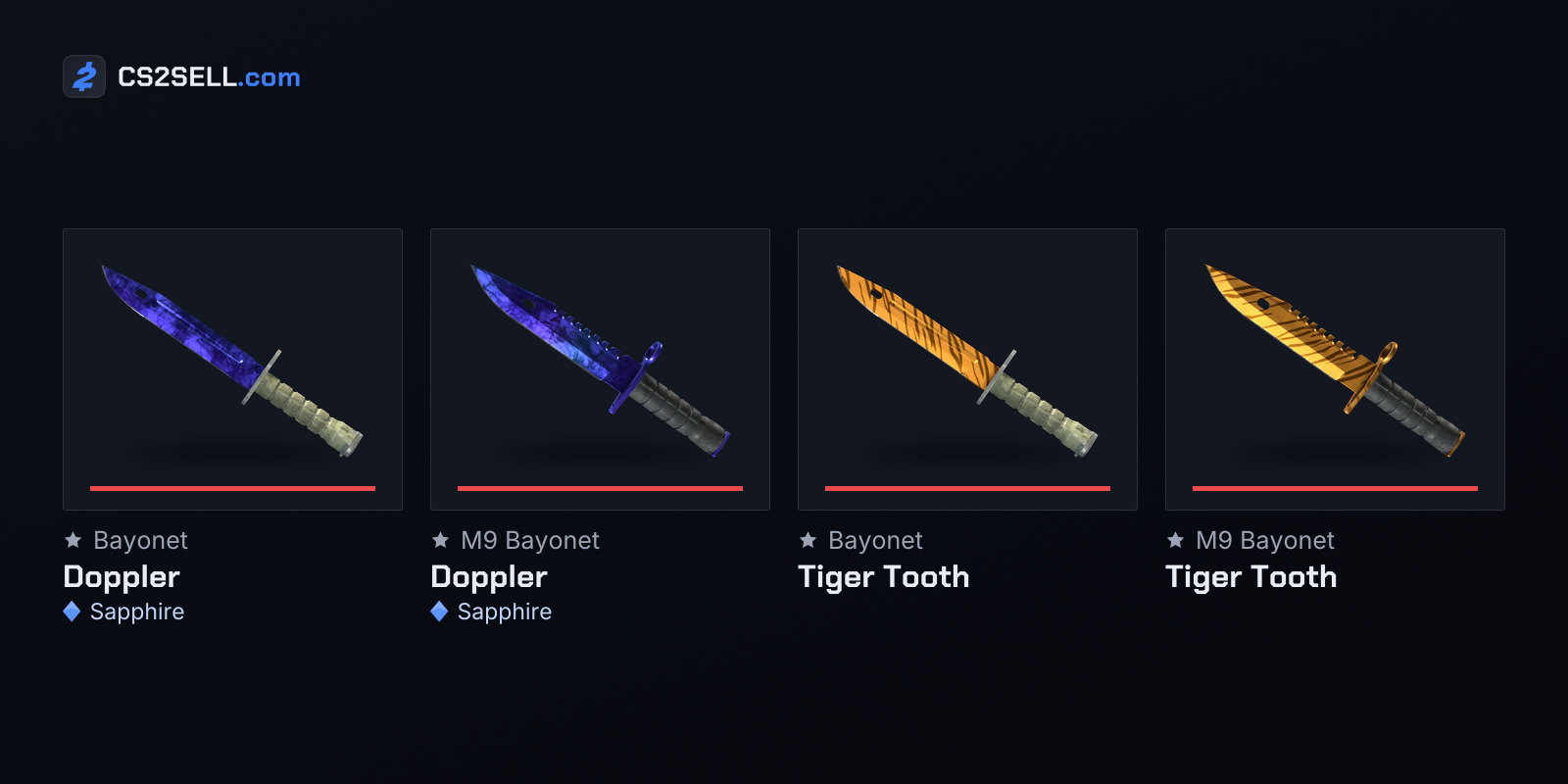
The Bayonet and the M9 Bayonet share a name, a release date and every case they drop from, so they are easy to mix up. They differ in blade shape, in a few animation details and in which rare patterns each can roll. This guide puts the two side by side.
Two bayonets from the Arms Deal update
Both knives arrived on August 14, 2013 with the Arms Deal update, in the first CS:GO Weapon Case. They are two of the five original knives, alongside the Karambit, Flip Knife and Gut Knife.
The Bayonet was not entirely new to players. The Counter-Strike Wiki notes that it served as the Counter-Terrorists' default knife in early test versions of CS:GO, before it became a rare special item. Valve's in-game description says the design has been "relatively unchanged" since World War II and that bayonet charges proved effective as recently as the second Gulf War and the war in Afghanistan.
The M9 Bayonet is described by Valve as a knife "originally intended to be mounted on a rifle" that also suits close-quarters combat. There is a naming quirk here. According to the wiki, the plain Bayonet is the one modelled on the real 1993 Buck M9 bayonet, while the in-game M9 Bayonet is based on a more modern design derived from it, with a serrated blade, and only takes the M9 name.
Both are cosmetic. They fight exactly like the default knife, with the same damage and range.
Animations
Hotspawn's guide to knife animations says the two share their animations and calls them fairly standard, with the M9 adding a slightly tweaked draw. The Counter-Strike Wiki singles out the Bayonet's draw, in which the character rolls the knife off the hand and catches it by the handle, as one of its best-known features.
Valve has adjusted the Bayonet in recent CS2 patches. An August 26, 2025 update changed its animation when you inspect straight after drawing, and a May 2026 update adjusted the finger animation on the Bayonet model.
Where they drop
The Bayonet and M9 Bayonet appear in exactly the same 16 cases as the Karambit. Hotspawn's trade-up guide lists the same groups, and the game's item files point every case in a group to one shared knife list:
| Finish line | Cases | Released |
|---|---|---|
| Original (12 plus vanilla) | CS:GO Weapon Case 1 to 3, eSports 2013, eSports 2013 Winter, eSports 2014 Summer, Operation Bravo, Winter Offensive, Operation Phoenix, Operation Vanguard, Revolver | 2013 to 2015 |
| Chroma | Chroma, Chroma 2, Chroma 3 | 2015 to 2016 |
| Gamma | Gamma, Gamma 2 | 2016 |
Both therefore come in the same 25 versions: vanilla, the 12 original finishes, the six Chroma finishes and the six Gamma finishes, all with StatTrak versions. Since October 2025, five Covert skins from one of these cases can also be traded up into one of the original knives, as our Covert trade-up article explains. Our Karambit guide goes through the case history in more detail.
Float ranges
Float caps are identical on both knives, since they use the same finishes. The ranges below come from the game's item definitions:
| Finish | Float range |
|---|---|
| Doppler, Gamma Doppler, Fade, Marble Fade, Tiger Tooth | 0.00 to 0.08 |
| Slaughter | 0.01 to 0.26 |
| Rust Coat | 0.40 to 1.00 |
| Freehand | 0.00 to 0.48 |
| Damascus Steel, Bright Water | 0.00 to 0.50 |
| Lore | 0.00 to 0.65 |
| Autotronic | 0.00 to 0.85 |
| Case Hardened, Blue Steel, Stained, Black Laminate | 0.00 to 1.00 |
| Crimson Web, Night, Ultraviolet and the camos | 0.06 to 0.80 |
So a Doppler or Fade on either knife only exists in Factory New and Minimal Wear, Slaughter stops at Field-Tested, and Rust Coat only comes in Well-Worn and Battle-Scarred. The game files also give each model its own Lore, Autotronic and Black Laminate paint, so those three finishes were drawn for each blade separately.
Patterns: where they differ
Marble Fade Fire & Ice. This is the biggest practical difference. The Steam Community's Fire & Ice guide lists the Bayonet among the four knives that can roll a true Fire & Ice, with red and blue on the play side and no yellow. The M9 Bayonet is on its list of models that can't.
On the Bayonet, seed 412 is the top "1st Max". The guide counts seven tiers within the first 24 pattern shifts and finds that 71 of 1,000 seeds qualify, about 7%. It also points out that the orange near the tip of a Bayonet is not the yellow that makes a knife a "fake" Fire & Ice.
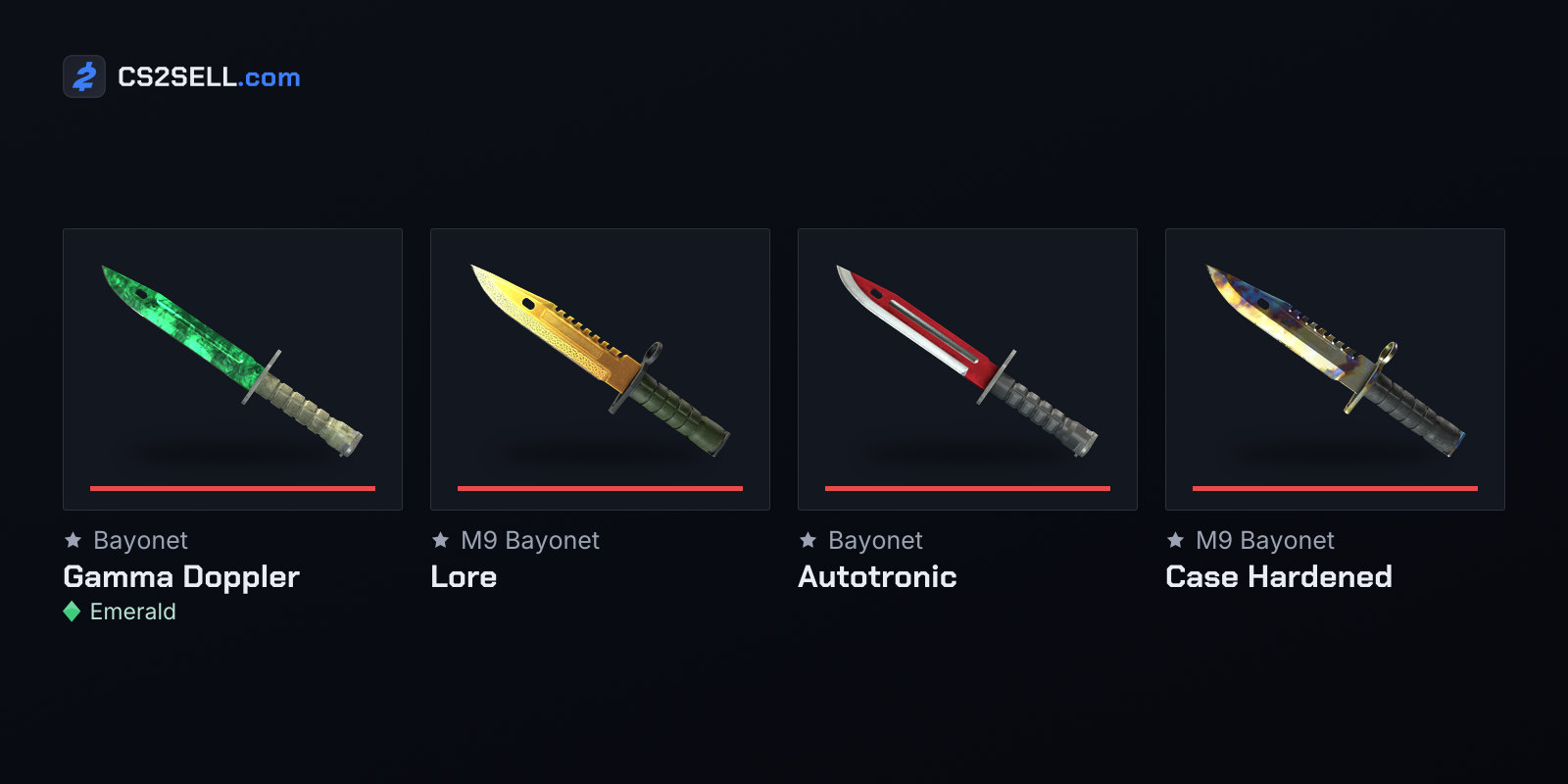
Doppler and Gamma Doppler. Phases work the same way on both knives. Our Doppler phases guide explains how to tell them apart.
Case Hardened and Fade. The seed decides how much blue shows on a Case Hardened and how the gradient sits on a Fade, and a strong seed on one model tells you nothing about the other. Our guides to blue gems and fade percentage cover both finishes.
Choosing between them
The two play identically, so the choice is about the blade you want to look at: the Bayonet's plain edge or the M9's serrations. For Marble Fade buyers, the Fire & Ice question decides it, because only the Bayonet can roll one.
Before you pay, inspect the item and open the information panel. The Finish Catalog number confirms a Doppler phase, and the Pattern Template is the seed to check against a Fire & Ice or blue gem list. On CS2Sell, Buy lets you pick either model and then filter by Doppler phase, paint seed, float and StatTrak.
Sources
- Bayonet — Counter-Strike Wiki
- M9 Bayonet — Counter-Strike Wiki
- CS2 Knife Animations - All Knives Explained — Hotspawn
- Knife CS2 Trade-Up Guide: Which Skins Give Which Knives — Hotspawn
- The Complete Fire & Ice Guide — Steam Community
- items_game.txt — GameTracking-CS2 on GitHub
- Counter-Strike 2 Update, August 26, 2025 — Counter-Strike 2 news
- Counter-Strike 2 Update, May 2026 — Counter-Strike 2 news